Harry Houdini magician, is probably the most famous magician/escapologist. His influence in the World is overwhelming. Even today, after his death in 1926, most people still know his name.
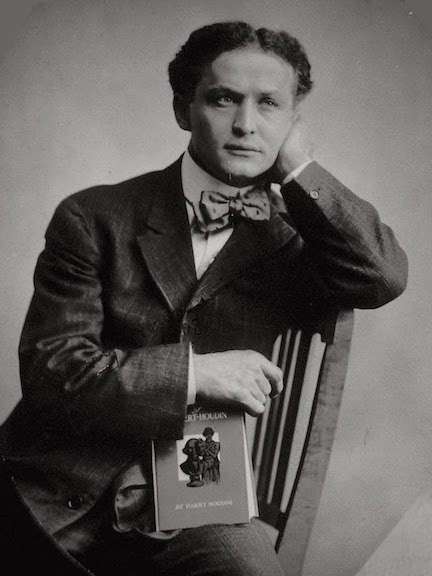
There are a wealth of facts available about him and his life.
Quick summary of Harry Houdini’s life
Harry Houdini was born Erik Weisz on March 24, 1874, in Budapest, Hungary.
His family immigrated to the United States when he was just a child, and they settled in Appleton, Wisconsin. To blend in with American culture, his name was changed to Ehrich Weiss, and later, as his career took off, he adopted the stage name “Harry Houdini” after French magician Jean Eugène Robert-Houdin.
Houdini began his career in entertainment as a trapeze artist at the age of nine, calling himself “Ehrich, the Prince of the Air.” His interest in magic blossomed as a teenager, and by the late 1890s, he was performing with his brother, Theo, in a vaudeville act. However, success was hard to come by, and Houdini struggled financially.
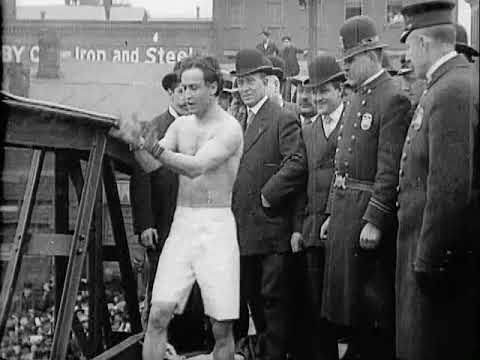
The turning point in Houdini’s career came in 1899 when he caught the attention of Martin Beck, a vaudeville impresario, in St. Paul, Minnesota. Beck suggested that Houdini focus on escape acts. This advice proved to be transformative, propelling Houdini to international stardom. His daring escapes from handcuffs, straitjackets, and locked containers captivated audiences worldwide. Notable escapes included being submerged in water-filled tanks and hanging upside down in straitjackets, as well as freeing himself from chains.
Houdini’s most famous act was the Chinese Water Torture Cell, where he was suspended by his feet and lowered into a glass tank filled with water, requiring him to escape whilst holding his breath. This act became a signature piece.
Throughout his career, Houdini’s determination to debunk fraudulent spiritualists and mediums was as strong as his magical feats. He was deeply skeptical of those who claimed to communicate with the dead, and he made it his mission to expose them. In 1926, he even testified before the United States Congress, advocating for legislation against fortune-telling. You can still go to the Library of Congress and see the Houdini documents.
Houdini’s friendship with Sir Arthur Conan Doyle, a firm believer in spiritualism, was strained due to these opposing views.
Houdini’s relentless pursuit of truth and spectacle made him a cultural icon. However, his life was not without controversy. He faced accusations of using hidden keys and other tricks to achieve his escapes, although he always maintained that his acts relied on skill and physical prowess.
Tragically, Harry Houdini’s life was cut short at the age of 52. On October 22, 1926, during a performance in Montreal, he was struck in the abdomen by a college student testing his claim that he could withstand any blow. Days later, he developed acute appendicitis and passed away on October 31, 1926, in Detroit, Michigan. Although, there is and has been much speculation on his death.
Despite his untimely death, Houdini’s legacy endures. He remains an enduring symbol of magic, showmanship, and the pursuit of truth. His influence can be seen in modern magicians who continue to be inspired by his incredible feats of escape and illusion. Houdini’s life story is a testament to the power of determination, creativity, and the human spirit’s boundless potential for wonder.

Blog posts where Harry Houdini is mentioned:
- Harry Houdini, a post from the day after his death.
- Harry Houdini’s most daring escapes.
- Magician vs Medium
- Did Dr. Lynn inspire Harry Houdini to take up magic?
- 20-books-to-learn-more-about-houdini
Another great resource for information on Harry Houdini is by the Houdini scholar John Cox, through his blog/ website: https://www.wildabouthoudini.com/
Back to Magicians Directory
Last updated on 2025-04-21